
Documented case study · San Juan de los Lagos, Jalisco, Mexico
From 8 to 36 Hours of Shelf Life Without Adding Preservatives
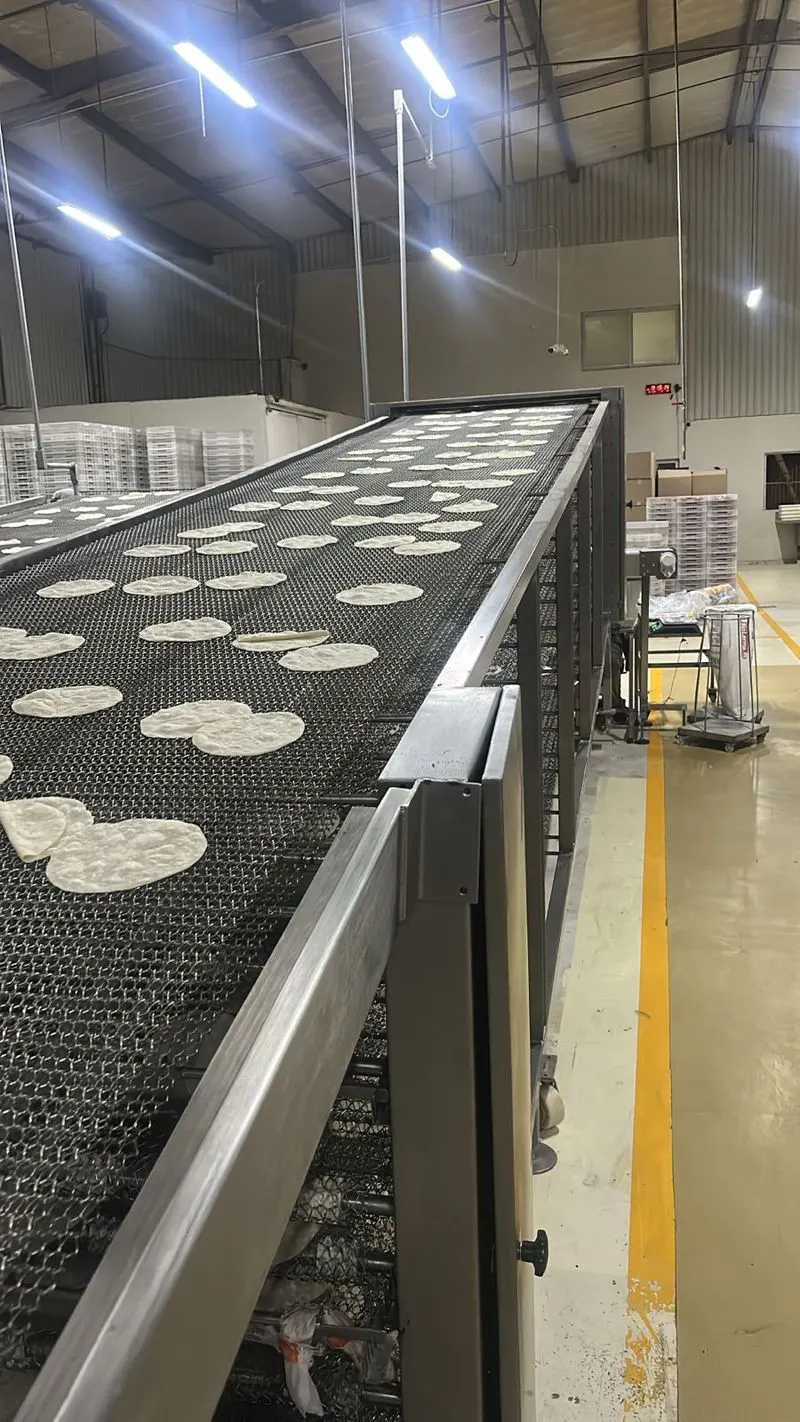
A tortilla plant in San Juan de los Lagos, Jalisco, Mexico, producing roughly 600 kg (1,323 lb) of corn tortillas a day, installed four UV-C X50 bars over its cooling conveyor, between the griddle and the packaging line. Its owner, Gustavo Romo, reports that mold went from appearing around the 8-hour mark to around the 36-hour mark, without changing the masa or adding chemical preservatives.
- ~600 kg/day (1,323 lb/day)
- 4 × X50 bars
- Cooling conveyor
- No preservatives
The critical point
The Problem Wasn't Hygiene — It Was the Window Between the Griddle and the Bag
A tortilla comes off the griddle nearly sterile. What decides how long it lasts isn't that step — it's what happens in the minutes right after.
Comes off the griddle with a very low load
Heat from the griddle drastically reduces the microbial load. At that moment the product is in its best microbiological condition of the entire process.
Recontaminated during cooling
While it travels the conveyor, the tortilla has high water activity and an exposed surface. Fungal spores suspended in the plant's air settle back onto it.
The bag seals in the moisture
When the bag closes, moisture stays trapped along with the load that just settled on it. The spores germinate and mold shows up sooner than a point of sale can tolerate.
The intervention
Four UV-C Bars Over the Existing Conveyor
The installation went over the cooling stretch, without modifying the line or stopping production.
Single layer, exposed surface
The tortilla travels flat and separated on the mesh. That's the condition that makes irradiation effective: UV-C light only acts on what it can directly reach.
The exact stretch: between the griddle and the packer
That's where the starting microbial load is set, the one the product carries into the bag. Irradiating earlier or later doesn't change the result.
No contact with the product, no formula change
UV-C light never touches the masa or adds anything to the recipe. The tortilla stayed corn, water and lime.
LED technology, not a mercury tube
On a food line, a mercury tube carries a breakage risk — glass and mercury landing on the product. UV-C LED removes that risk.
The result
Mold Onset Went From About 8 Hours to About 36 Hours
What the customer valued most wasn't the extra hours themselves, but their commercial consequence: more hours without mold means more points of sale reachable without a cold chain. Shelf life stopped being the ceiling on his delivery radius.
“Before, mold would show up very fast. I had complaints all the time, returns from points of sale. After installing the UV-Life system, that disappeared. Now I distribute farther and the tortillas arrive in perfect condition.”
What the technology actually does
What UV-C Light Does and Doesn't Do
It reduces the load. It doesn't guarantee absence.
Less microbial load on the surface means slower proliferation, and therefore more hours before mold becomes visible. That's the entire mechanism — and it's worth stating just as clearly where it stops.
What it does
- Reduces the microbial load on the irradiated surface of the product
- Acts on a stretch of the process, without adding anything to the formulation
- Doesn't change the product's taste, color, aroma or temperature
- Delays mold onset by lowering the starting load before packaging
- Works continuously on the line, without stopping production
What it doesn't do
- Doesn't penetrate the product: it acts only on the surface it reaches
- Doesn't reach hidden faces if the product travels stacked or overlapped
- Doesn't reverse mycotoxins that have already formed or fix contaminated product
- Doesn't eliminate spores completely: they require higher doses than vegetative bacteria
- Doesn't replace good hygiene practices or the plant's HACCP plan
Why it matters beyond tortillas
Why This Case Matters Even If You Don't Make Tortillas
There's nothing special about a tortilla. What makes it a good case study is that it combines three conditions that repeat across many food processes.
A moist, exposed surface right after a heat or wash step
The product comes out with a low load but stays vulnerable to environmental recontamination before the package is sealed.
A single-layer stretch in the process
Without that stretch, the light can't reach the surface and the technology doesn't apply. It's the condition that determines whether the case is replicable.
A short shelf life that caps the business
Whether it's shrinkage, returns from points of sale, or delivery radius, short shelf life is what's setting the commercial ceiling.
Where all three line up, the mechanism is the same: fresh dough and baked goods, leafy greens after washing, deli meats and cold cuts before packaging, shredded and aged cheeses. What changes case to case is the dose, the conveyor speed and the exact point of installation.
Frequently asked questions
About This Case and How It Applies Elsewhere
Why does mold appear on tortillas so quickly?
A tortilla leaves the griddle with a very low microbial load, but travels the cooling conveyor with high water activity and an exposed surface. In that stretch, spores suspended in the plant's air settle back onto it. Once packaged, the moisture stays trapped along with that load and the spores germinate. It's not a cleanliness problem — it's the starting microbial load the product enters the bag with.
How much did shelf life increase in this case?
The customer reports mold going from appearing around 8 hours to around 36 hours. These are values from his own operation and from the response of his points of sale, not a controlled lab trial or a guaranteed equipment specification. The result depends on the process, conveyor speed, the plant's ambient microbial load and its hygiene practices.
Does UV-C light replace preservatives?
UV-C light acts on the surface of the product during the process, not inside the masa. It reduces the microbial load before packaging, which delays mold onset. In this case the customer operated without preservatives, but the result depends on the process, conveyor speed and each plant's hygiene practices.
Do you have to modify the production line to install UV-C?
In this case, no. The UV-C bars were mounted on the existing cooling conveyor, in the stretch between the griddle and the packer, without stopping production. What is defined case by case is the mounting height and the number of units, because that's what sets the dose the product receives.
Is it safe for plant staff?
UV-C light isn't a laser and doesn't cause immediate harm — it's the same germicidal band found in sunlight. Even so, it's best to avoid prolonged, continuous accidental exposure, the same way you'd avoid hours of unprotected sun. That's why the units are mounted facing the conveyor and outside the operator's normal line of sight at their workstation, something we account for in every installation design.
Does this case apply to foods other than tortillas?
The mechanism applies wherever three conditions are met: a product with a moist, exposed surface after a heat or wash step, a single-layer stretch of the process where the light can reach that surface, and a short shelf life that caps the business. That's true for fresh dough and baked goods, leafy greens, deli meats and cold cuts, and cheeses — with a different dose and installation point in each case.
What doesn't UV-C light do to a food product?
It doesn't penetrate the product: it acts only on the irradiated surface. It doesn't reach hidden faces if the product travels stacked. It doesn't reverse mycotoxins that have already formed. It doesn't eliminate spores completely, because fungal spores require higher doses than vegetative bacteria. And it doesn't replace good hygiene practices or the plant's HACCP plan: it's an added preventive layer, not a substitute control.
Why LED instead of a germicidal mercury tube?
On a food line, a mercury tube carries two risks the LED doesn't: breakage with glass landing on the product, and mercury contamination. UV-C LED also emits concentrated in the DNA absorption range, between 260 and 285 nm, and is rated for more than 10,000 hours of service without swapping tubes.
Take the next step
Does Your Process Have a Similar Stretch?
Tell us about your line and where the shelf-life problem shows up. We'll review whether there's an applicable stretch and tell you honestly whether the technology fits your case or not.