
UV-C LED Disinfection with no mercury and no chemicals at the 265 nm germicidal peak
bacteria and fungi*
Ultraviolet C light, emitted at the 265 nm germicidal peak with mercury-free LED technology — the wavelength most effective at damaging the DNA or RNA of microorganisms.

The heart of the technology: the LED chips
We build the LED chips into lights, bars and fixtures like this one: 25 UV-C LED diodes emitting Type C ultraviolet radiation between 260 and 280 nm, centered on 265 nm — the wavelength where UV-C light damages the DNA or RNA of microorganisms most effectively.
Reduce Viruses, Bacteria and Fungi in
UV-Life's UV-C light reduces microbial load on four fronts. Choose your application to see the equipment and studies for each one.
Food
Extends shelf life without chemicals, reducing mold and bacteria on production lines.
See Application →Surfaces
UV-C disinfection for laboratories, process rooms and work surfaces.
See Application →Air
Fixed and portable sanitizers that reduce airborne microorganisms in your spaces.
See Application →Water
UV-C disinfection for process and drinking water, without altering the product.
See Application →What Is UV-C Light and How Does It Disinfect?
Ultraviolet C (UV-C) light occurs naturally in sunlight, but most of it never reaches the ground because the ozone layer absorbs it. Its germicidal power sits in the 200 to 300 nanometer range. It damages the DNA or RNA of microorganisms and prevents them from replicating.
Watch How UV-Life Reduces Microorganisms
Watch in real time how UV-C technology reduces viruses, bacteria and fungi in seconds.
Watch Video →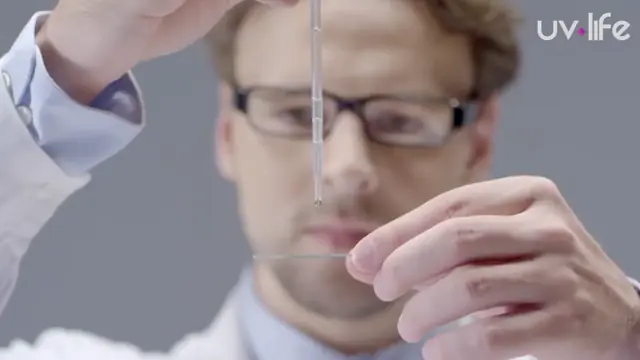
Is UV-C LED Better Than a UV Mercury Lamp?
Yes. UV-C LED is safer to use for air, surface and food disinfection than mercury tube technology because it contains no mercury, and it's more efficient because it emits directly at the 265 nm germicidal peak — the wavelength most effective at damaging microbial DNA or RNA. It also switches on instantly, with no warm-up delay.
Traditional Germicidal Tube
- Contains mercury (hazardous waste)
- Emission scattered outside the germicidal peak
- Risk of ozone generation
- Fragile, with a shorter service life
UV-Life's UV-C LED
- 100% LED, no mercury, no waste
- Emits at the germicidal peak: 265 nm
- Produces no ozone
- Directional and more efficient
Is UV-C Disinfection Proven to Work?
Yes. UV-Life's UV-C technology is backed by customers across 5 countries, internal and customer microbiology studies, and government validations including Chile's MINSAL health authorization, ISP registration, and independent testing from SGS and Bureau Veritas — all documented in detail on our scientific evidence page.
Internal and Customer Studies
Multiple microbiology studies, with and without UV-C, show reduced coliforms, mesophilic aerobic counts, mold and yeast on food, surfaces and process water.
Government Validations
Backed by official agencies and laboratories: Chile's MINSAL, ISP, SGS and Bureau Veritas have each certified UV-Life's UV-C technology.
International Reach
Food, beverage and healthcare companies rely on UV-Life across Mexico, Chile, Argentina, Peru and Uruguay.
Industry Leaders Choose UV-Life
Industry leaders and fast-moving operators raising their food-safety standards choose UV-C disinfection from UV-Life.


Effectiveness Depends on 4 Variables
There's no single answer: the right UV-C dose for each target determines how much microbial load is reduced.
Power
The UV-C energy the equipment delivers determines the dose available.
Time
The longer the exposure time, the greater the cumulative dose on the target.
Distance
Irradiance decreases with the distance between the source and the surface.
Geometry
The shape of the product being disinfected determines which surfaces are exposed.
We'll Help You Choose the Right Product
UV-Life advises you on the right product for your operation and your food-safety goals. We define the dose, distance and exposure time for your case.
Is UV-C Light Safe for People?
Yes, when used correctly. UV-C light isn't a laser that causes instant harm, but prolonged direct exposure of skin and eyes should be avoided, the same way you'd limit time in strong sun. UV-Life equipment supports directional irradiation, and several models include occupancy sensors for safe, unattended operation.
It's Not a Laser
UV-C isn't a laser that will cause instant harm. It's germicidal radiation that should be used with the same judgment as any other ultraviolet light source.
Avoid Prolonged Exposure
Avoid prolonged exposure of skin and eyes, the same way you would with the sun. Overexposure can cause irritation.
Directional Irradiation and Sensors
Our products support directional irradiation, and some include occupancy sensors for safe operation.
- • Do not expose people directly to ultraviolet light.
- • Ultraviolet C light does not pass through glass.
Frequently Asked Questions About UV-C Light
Yes, and it's one of the applications where UV-C LED outperforms mercury tube technology. A tube loses output below 50°F (10°C) and takes minutes to stabilize; a 265 nm UV-C LED reaches full power instantly and cold does not degrade it. It mounts on the ceiling or over chamber racks and runs during unstaffed shifts, cutting the airborne and surface mold, spore and bacterial load that causes mold on refrigerated product.
No. UV-C LED disinfection uses no chemicals and produces no ozone or mercury residue, so it leaves nothing behind on the food or surface it treats. It reduces microbial load only on the surface it directly reaches — it does not penetrate the product, glass or packaging, so line design still needs to plan for direct exposure.
UV-C light occurs naturally in sunlight, but most of it never reaches the ground because the ozone layer absorbs it. Its germicidal power sits between 200 and 300 nanometers. It damages the DNA or RNA of microorganisms and prevents them from replicating.
Unlike a tube, UV-C LED is safer because it contains no mercury, and it's more efficient because it emits at the germicidal peak: 265 nm, the wavelength most effective at damaging the DNA or RNA of microorganisms.
Four variables: the equipment's power output, exposure time, distance to the target and the geometry of the product being disinfected. UV-Life advises on the right product for your setup and your food-safety goals.
It's not a laser that will cause you instant harm. Prolonged exposure of skin and eyes should be avoided, the same way you would with the sun. Our products allow directional irradiation and some include occupancy sensors.
A UV-C LED light contains no mercury, so it generates no hazardous waste and no risk of contamination if it breaks. It also emits at the 265 nm germicidal peak, while a tube spreads its energy across other wavelengths. LED technology also lasts more than 10,000 hours and supports directional irradiation.
It depends on the dose, which comes from four variables: equipment power, exposure time, distance to the surface and the object's geometry. At close range with adequate power, reduction happens in seconds; larger spaces need longer cycles. UV-Life defines the right dose for each case.
People should not be directly exposed to UV-C radiation. Our equipment allows directional irradiation aimed at the treatment zone, and some models include occupancy sensors that interrupt emission, so disinfection happens without exposing staff.
LED technology needs no tube replacement and no mercury waste handling. Maintenance is limited to periodically cleaning the emitting surface, since dust reduces effective irradiance, and replacing the unit at the end of its service life, which exceeds 10,000 hours of use.
Let's Raise Your Food-Safety Standards
Tell us about your application — food, surfaces, air or water — and we'll help you choose the UV-C equipment that fits your operation.