Verifiable Evidence

Scientific Evidence: UV-C Light Microbiology Studies

Every study on this page is published with its matrix, the parameter measured, the result with and without UV-C light, the laboratory that issued it, and an image of the original report. We also include what each test does not prove: Type C ultraviolet light is a surface microbial load-reduction tool, not a sterilant.

Studies

What Testing Backs UV-C Disinfection?

Five independent studies run in real production plants and at an accredited laboratory back UV-Life's UV-C disinfection: coliform counts in food, process water quality, an SGS-verified viral inactivation test, and a full microbiological profile from Analab. Every result is published as text so it can be verified, cited and shared.

Food

Coliforms in Chard: 38 vs 62 CFU/g With and Without UV-C

Matrix Analyzed
Fresh chard (leafy green vegetable)
Parameter
Total coliforms
Result With UV-C
38 CFU/g
Result Without UV-C
62 CFU/g
Variation
−39%
Laboratory
Laboratorio Italiano · Mendoza, Argentina
Customer / Plant
Rie La Huerta
Report Date
March 17, 2026
Regulatory Reference
Argentine Food Code

What the Report Shows

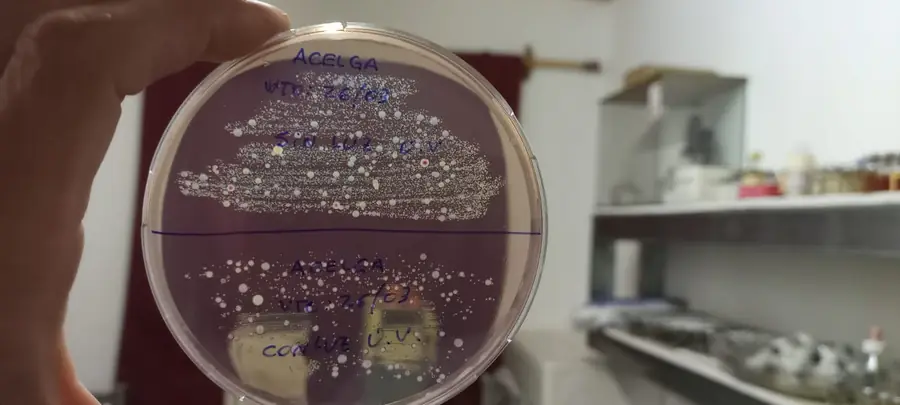
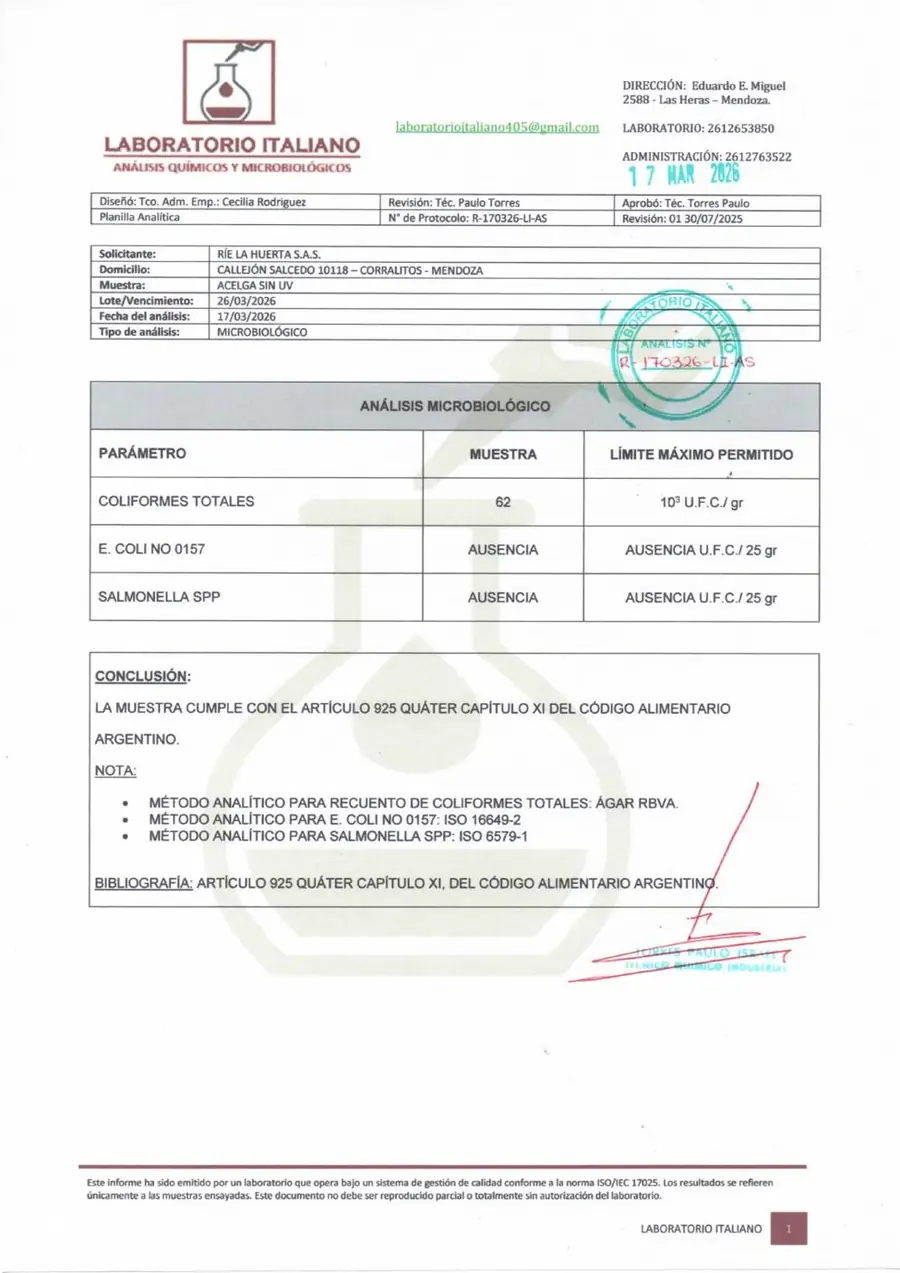
Two samples from the same batch of chard, one treated with UV-C light and one untreated, analyzed by the same laboratory. The treated sample showed 38 CFU/g of total coliforms versus 62 CFU/g for the untreated sample — a 39% reduction from the starting load. Both samples stayed below the limit set by the Argentine Food Code.

What It Doesn't Prove

It doesn't demonstrate sterilization or the total absence of coliforms. It also can't be extrapolated to other vegetables or other line configurations: the result depends on the UV-C dose applied, the distance and the exposure time on the product's surface.
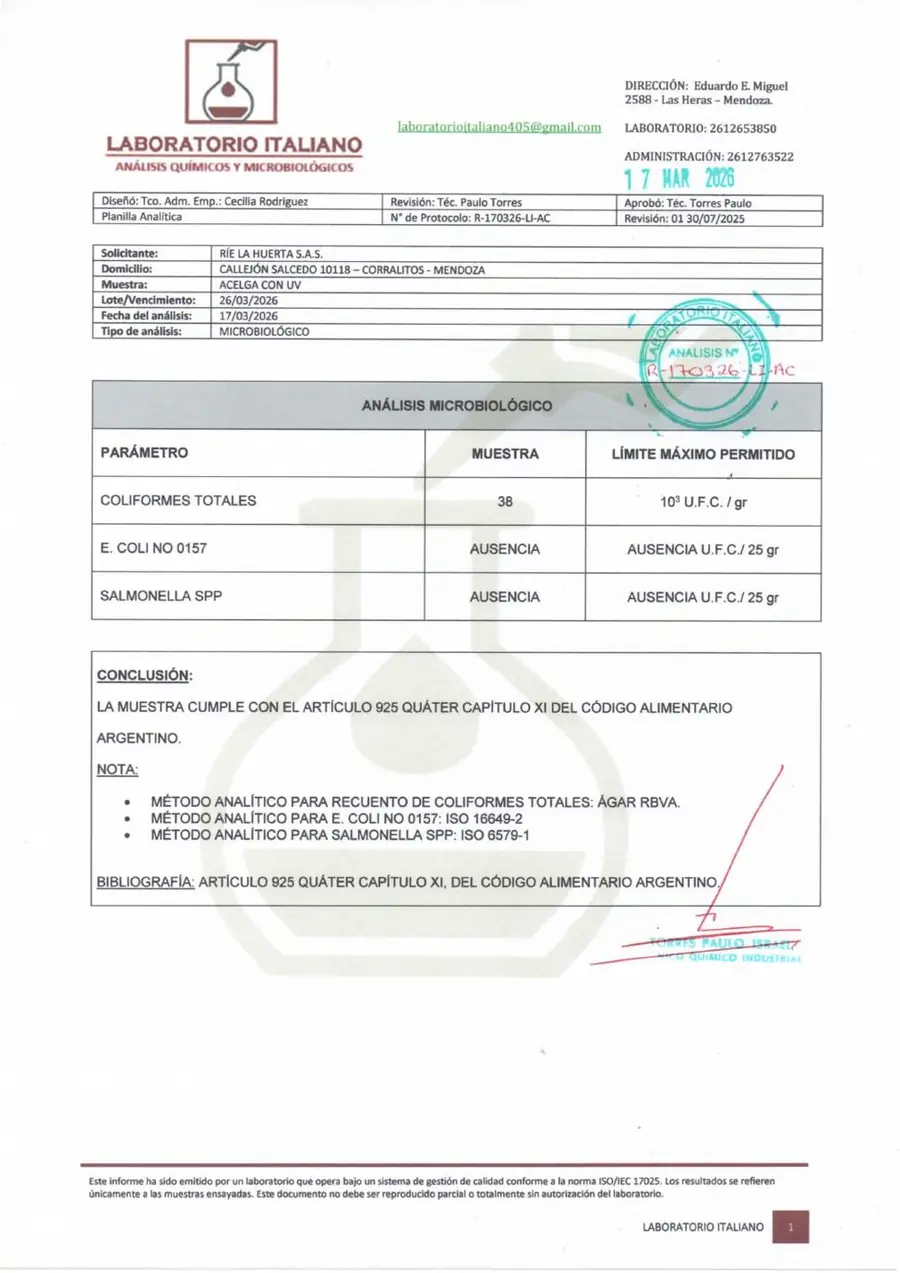
Laboratory report of total coliforms in chard treated with UV-C light: 38 CFU/g, Rie La Huerta, Mendoza
Laboratory report of total coliforms in untreated chard: 62 CFU/g, Rie La Huerta, Mendoza
Photograph of chard culture plates with and without ultraviolet UV-C light treatment
Equipment Surface

Coliforms on Ice Cream Vat: No Colonies After 24 Hours

Matrix Analyzed
Ice cream vat surface (process equipment)
Parameter
Coliforms
Result With UV-C
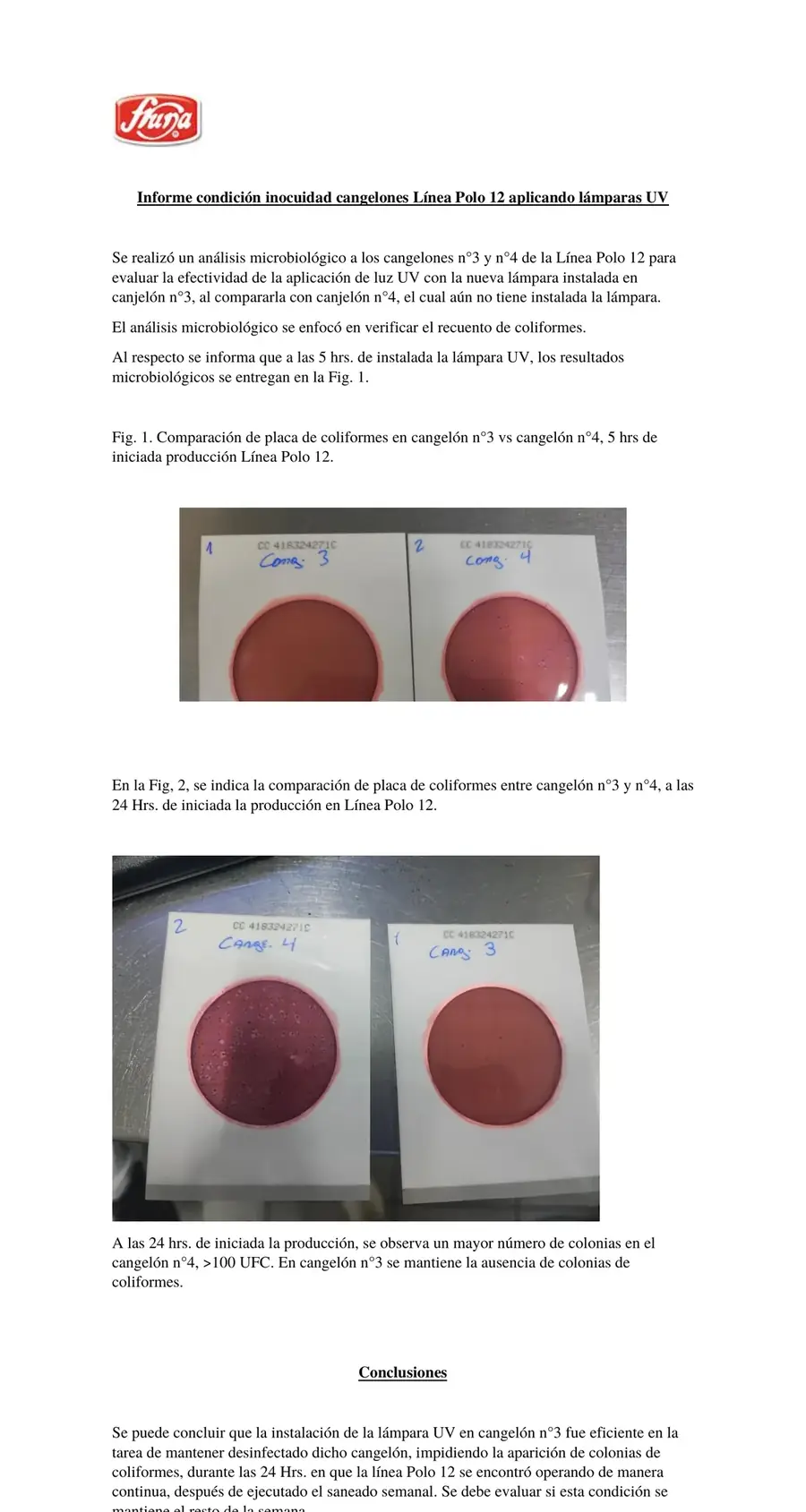
No colonies detected
Result Without UV-C
More than 100 CFU
Condition
24 hours of continuous production
Laboratory / Report
Fruna Report · Polo 12 Line
Customer / Plant
Fruna · Chile
Report Date
January 20, 2025

What the Report Shows

Side-by-side comparison of two vats on the same ice cream line: vat No. 3 with a UV-C lamp installed and vat No. 4 without one. After 24 hours of continuous production, the vat without UV-C exceeded 100 CFU of coliforms, while the one running with UV-C showed no colonies at all.

What It Doesn't Prove

It measures the load on the equipment surface, not on the finished product. It doesn't replace the plant's cleaning and sanitation program — it's a complementary measure that keeps recontamination low between sanitation cycles.

Coliform report on the ice cream vat of Fruna's line, comparing the equipment with and without a UV-C lamp
Process Water

Process Water: From 20-35 CFU/mL to Under 1 CFU/mL After UV-C

Matrix Analyzed
Plant supply water
Parameter
Mesophilic aerobic count (MAC)
Result Before UV
20-35 CFU/mL
Result After UV
Under 1 CFU/mL
Condition
Three consecutive days of sampling
Laboratory / Report
Certificate of analysis
Customer / Plant
Quillayes/Surlat · Loncoche, Chile
Report Date
October 7, 2025

What the Report Shows

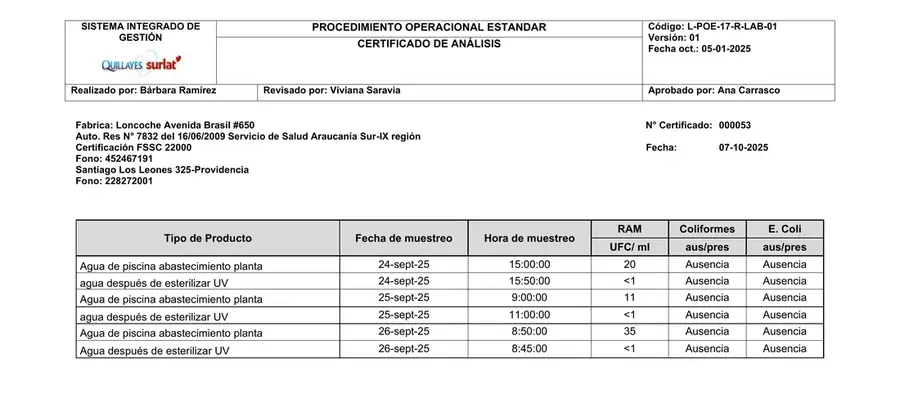
Supply water samples taken before and after the UV sterilization unit, on three consecutive days. The mesophilic aerobic count went from 20-35 CFU/mL at the inlet to under 1 CFU/mL at the outlet in every sampling round.

What It Doesn't Prove

UV-C's effectiveness in water depends on transmittance: in turbid water or water with a high organic load, performance drops because suspended particles block the radiation. It doesn't replace upstream filtration.

Certificate of analysis for mesophilic aerobic count in process water before and after UV-C light treatment, Loncoche plant
Air and Surface

Viral Inactivation Above 99.99% — SGS Test

Matrix Analyzed
Air and surface of an enclosed space
Parameter
H1N1 virus inactivation
Result
Above 99.99%
Test Distance
2 meters
Equipment Tested
UV-Life room sterilizer
Laboratory
SGS
Report No.
Test Report GZF20-014499
Report Date
August 13, 2020

What the Report Shows

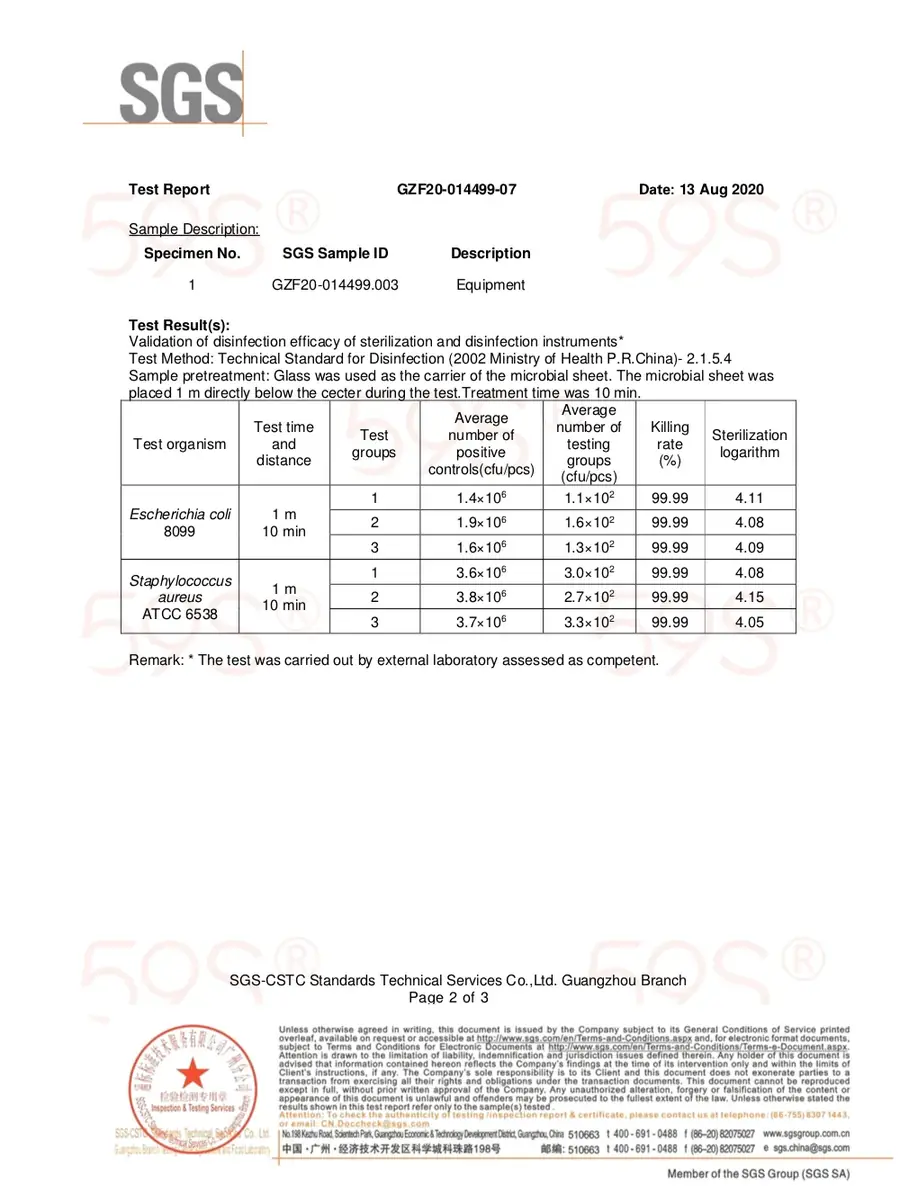
H1N1 virus inactivation test performed by SGS on a UV-Life room sterilizer, with the unit positioned 2 meters from the test surface. The measured inactivation rate was above 99.99%.

What It Doesn't Prove

It's a germicidal efficacy test under controlled laboratory conditions, on a room disinfection unit. It's not a food production line result and doesn't carry over directly to the surface of a product moving on a conveyor.

SGS Test Report GZF20-014499 for H1N1 virus inactivation with UV-Life ultraviolet UV-C light
Dehydrated Food

Microbiological Profile of Powdered Avocado Pit — Analab

Matrix Analyzed
Dehydrated, powdered avocado pit
Molds
Under 10 CFU/g
Yeasts
200 CFU/g
Escherichia coli
Under 10 CFU/g
Staphylococcus aureus
Under 10 CFU/g
Salmonella
Not detected
Laboratory
Analab Chile S.A.
Accreditation
ISO 17025
Report Date
January 20, 2026

What the Report Shows

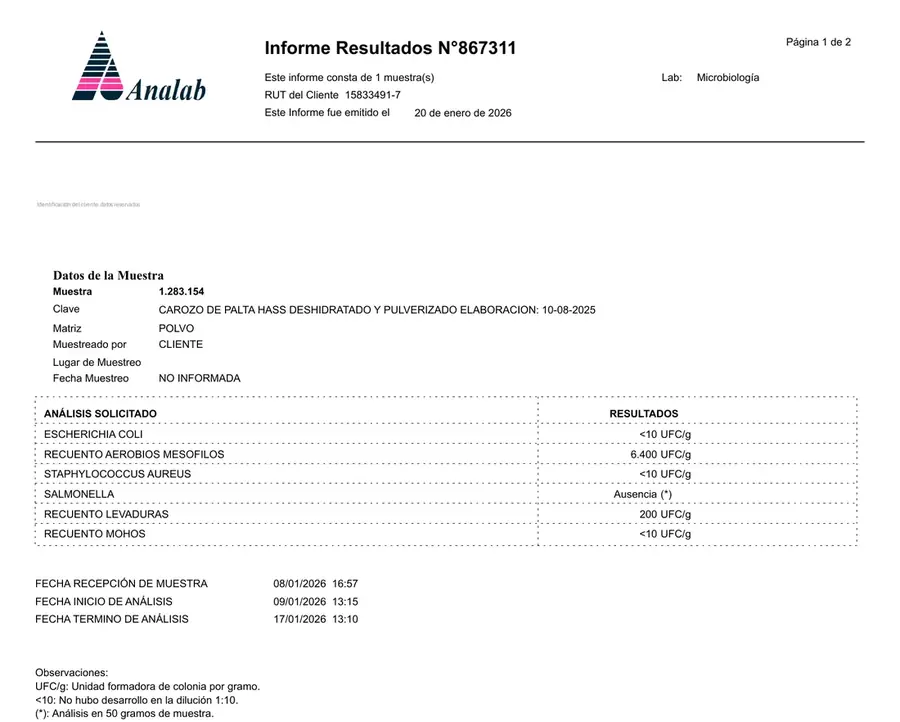
Complete microbiological profile of the finished product, a dehydrated and powdered ingredient, analyzed by a laboratory accredited under ISO 17025.

What It Doesn't Prove

This is a food-safety characterization of the finished product, not a with/without UV-C comparison. These values can't be attributed to the ultraviolet treatment alone.

Analab Chile S.A. microbiology report for powdered avocado pit: molds, yeasts, E. coli, S. aureus and Salmonella
Documentation

Equipment Testing and Certifications

These documents certify the equipment itself: its germicidal efficacy testing and its health and product registrations. They're different from the microbiology studies in the previous section, which measure the effect on a specific matrix in a specific plant.

SGS Testing on the Equipment

SGS test reports on the UFO lamp and the UV-C panel, covering germicidal efficacy validation for the equipment.

View the original SGS report (PDF) ↗

IFC Tower Two Test Report

Field test report conducted at IFC Tower Two.

Demonstrations

See It Work

Inactivating a Paramecium Under the Microscope

Under a microscope, we exposed a paramecium — a microorganism common in stagnant water — to ultraviolet light emitted by UV-Life. The video shows it losing mobility within seconds.

Watch the Video →
UV-Life video thumbnail: microscope observation of a paramecium inactivated by ultraviolet UV-C light
Technical Honesty

What Can and Can't UV-C Light Do?

We publish the technology's limits with the same detail as its results. A vendor that only lists strengths isn't a trustworthy source.

Reduces Surface Microbial Load

UV-C damages the DNA of bacteria, fungi and viruses on the exposed surface, stopping their ability to reproduce.

Doesn't Penetrate the Interior of the Product

It only acts on what receives direct radiation. It doesn't treat the interior of a food product, or anything shadowed by an irregular surface.

Doesn't Reverse Toxins Already Formed

Mycotoxins and aflatoxins already present in the product are not removed by UV-C. It's a load-reduction tool, not a remediation method.

Bacterial Spores Are More Resistant

Sporulated forms require much higher doses than vegetative cells. Spore elimination cannot be claimed.

Dose Determines the Result

Power, distance and exposure time determine how much load is reduced. A result obtained on one line can't be extrapolated to another without validation.

Doesn't Replace Your Food-Safety System

It's a complementary control measure within GMP and HACCP programs. It doesn't replace the cold chain, cleaning, or your food-safety management plan.

Frequently Asked Questions

Questions About the Scientific Evidence for UV-C Light

Is there research supporting UV-C light disinfection?

Yes. This page collects microbiology studies run by outside laboratories on real products and processes: coliforms in chard (38 vs 62 CFU/g with and without UV-C), process water (from 20-35 CFU/mL to under 1 CFU/mL), viral inactivation above 99.99% verified by SGS and a microbiological profile of powdered avocado pit by Analab.

What percentage of viruses, bacteria and fungi does UV-C light eliminate?

In the SGS test, viral inactivation exceeded 99.99% under controlled laboratory conditions. In a plant, the result depends on the dose applied, the distance and the exposure time on each surface, so every case needs its own validation.

Are UV-Life's studies from independent laboratories?

Yes. The reports come from outside laboratories and agencies: SGS, Analab Chile S.A. (ISO 17025 accredited), Bureau Veritas, plus the health authorization from Chile's MINSAL and registration with Chile's ISP.

Does UV-C light eliminate Listeria and Salmonella?

UV-C light reduces the surface load of bacteria such as Listeria monocytogenes and Salmonella spp. by acting on their DNA. It's a surface load-reduction measure: it doesn't penetrate the interior of the food, and it doesn't replace the cold chain or your food-safety plan.

Does UV-C light eliminate bacterial spores?

Bacterial spores are considerably more resistant to UV-C radiation than vegetative cells and require much higher doses. That's why UV-C should not be considered a sterilization method against spores — it's a microbial load-reduction method.

Does UV-C light replace a HACCP plan?

No. UV-C is integrated as a complementary control measure within Good Manufacturing Practice programs and HACCP plans, reducing microbial load at defined points in the process, without replacing the food-safety management system.

Take the Next Step

Need a Study for Your Own Product?

We'll define the right UV-C dose for your line and, where it fits, run a pilot with before-and-after lab analysis on your own product matrix.

Scroll To Top